Agentic Software Engineering Needs Strong DevOps Foundations (More Than Ever)

The Age of AI Agents Has Arrived, Is Your Engineering Culture Ready?
Agentic software engineering is no longer a future concept. AI coding agents, autonomous pull request generation, self-healing pipelines, and AI-assisted operations are already reshaping how teams design, build, test, and ship software every single day.
And here's the uncomfortable truth most teams aren't ready to hear:
Agents don't magically fix broken engineering practices. They scale them.
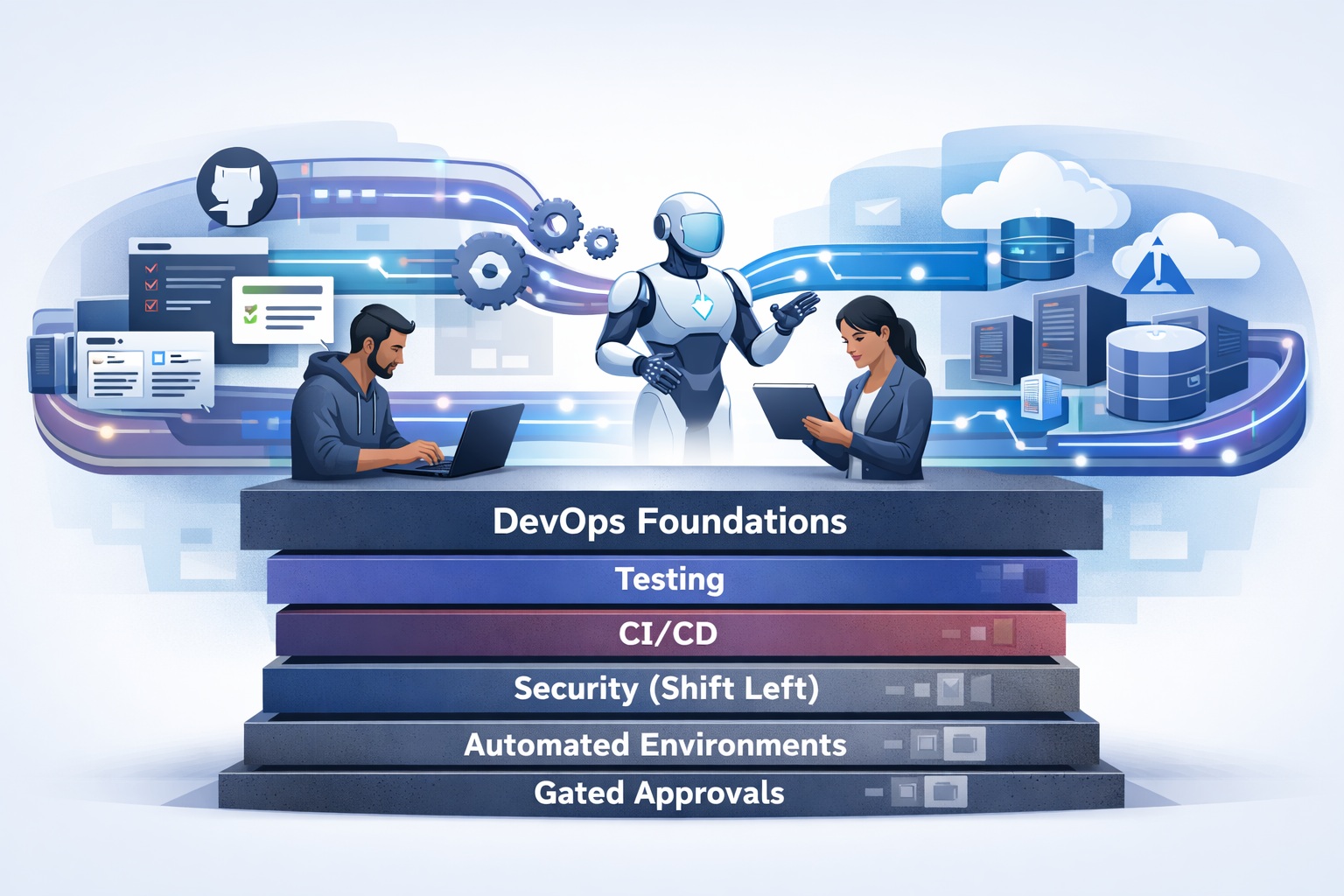
If your DevOps foundations are weak, agentic systems could introduce bugs faster, accumulate technical debt at record speed, and introduce security risks you'll discover far too late. If your foundations are strong, agents become a force multiplier, unlocking velocity, consistency, and quality at a level that was previously impossible.
This post explores why strong DevOps practices are a prerequisite, not an afterthought for successful agentic software engineering, particularly in GitHub and Microsoft Azure–based environments.
Agentic Engineering Is Acceleration, Not Autopilot
Agentic systems today excel at:
- ✅ Generating and refactoring code across languages and frameworks
- ✅ Creating pull requests with context-aware descriptions
- ✅ Writing tests (with varying degrees of quality)
- ✅ Updating dependencies and addressing vulnerabilities
- ✅ Proposing infrastructure-as-code changes
- ✅ Responding to operational signals like alerts and incidents
But here's what agents cannot do reliably:
- ❌ Understand business context, risk tolerance, or strategic direction
- ❌ Make architectural decisions with long-term consequences
- ❌ Evaluate tradeoffs between competing non-functional requirements
- ❌ Navigate organizational politics or compliance requirements
Think of agents as junior engineers with infinite stamina, extremely fast, but literal. They're capable of learning patterns, but not intent. That means your processes, pipelines, and guardrails become the real "brain" of your engineering organization.
The question isn't "Can an agent write this code?" The question is "Does our engineering system ensure this code is safe to ship?"
Why DevOps Maturity Matters More in an Agentic World
Traditional DevOps already aimed to reduce friction, increase reliability, and improve feedback loops. Agentic engineering turns those goals into non-negotiable survival requirements.
| Without Strong DevOps | With Strong DevOps | |
|---|---|---|
| Pull Requests | Agents open PRs that compile but fail in production | Agents become safe collaborators with automated validation |
| Security | Vulnerabilities propagate faster than humans can review | Quality gates enforce standards consistently and automatically |
| Environments | Inconsistent setups create nondeterministic failures | Automated environments provide reliable testing playgrounds |
| Code Review | Teams "accept" AI output just to keep up, compounding debt | Developers spend time reviewing intent, not syntax |
| Velocity | Speed increases but trust erodes | Velocity increases without sacrificing trust |
The pattern is clear: DevOps maturity determines whether agents create value or chaos.
1. Strong Testing Is the First Line of Defense
In an agent-assisted workflow, tests are no longer just documentation, they are executable contracts that determine whether AI-generated code survives.
What "Strong Testing" Means in Practice
- Unit tests that assert behavior, not implementation details
- Integration tests that validate real dependencies and service interactions
- Contract tests between services (especially in microservice architectures)
- Performance and load tests baked directly into CI/CD pipelines
- Mutation testing to validate the quality of your test suite itself
When agents generate or modify code, tests become:
- The fastest feedback mechanism for correctness
- The primary signal that determines merge eligibility
- The boundary that prevents silent regressions from reaching production
GitHub + Azure in Action
- GitHub Actions running unit and integration tests on every pull request
- Azure Test Plans or custom frameworks validating end-to-end scenarios
- Required status checks before merge, no exceptions
- GitHub Copilot generating tests, but pipelines ruthlessly enforcing them
The golden rule: Agents should propose code. Tests should decide whether it lives.
2. Shift-Left Security Is Mandatory, Not Aspirational
Agentic systems can generate secure code, but they can also confidently generate insecure patterns when your repositories allow it. AI models don't inherently understand your threat model, they optimize patterns they've seen before.
This is where shift-left security becomes a hard technical requirement, not a best-practice poster on the wall.
What Needs to Move Left
| Security Practice | Tool / Approach |
|---|---|
| Static code analysis (SAST) | CodeQL on every PR |
| Dependency scanning | Dependabot alerts + auto-remediation |
| Secret detection | Secret scanning with push protection |
| Infrastructure-as-Code validation | Azure Policy, Bicep linting |
| License compliance | Dependency review action |
| Container image scanning | Microsoft Defender for Containers |
GitHub Advanced Security + Azure
With GitHub Advanced Security (GHAS) and Microsoft Defender for Cloud, you get a comprehensive security posture that works seamlessly:
- CodeQL scanning analyzes every PR for vulnerabilities before merge
- Dependabot automatically creates PRs to update vulnerable dependencies
- Secret scanning with push protection blocks commits containing secrets before they ever reach the repo
- Azure Policy validates infrastructure definitions against compliance rules before deployment
Security findings should block merges automatically, without debate. Agents don't get offended. Developers shouldn't have to argue with scanners either.
3. Automated Staging Environments: The Agent Playground
One of the biggest enablers of safe agentic workflows is automated, disposable environments. If agents are proposing changes continuously, you need a place where those changes can be validated in reality, not just in theory.
Best Practices for Ephemeral Environments
- One environment per pull request automatically provisioned
- Full parity with production real cloud resources, not mocks
- Automatic teardown after merge or close, no lingering costs
- Preview URLs shared in PR comments for visual validation
- Integration test suites that run against the ephemeral environment
Azure-Native Approach
- Azure Deployment Environments for self-service, governed infrastructure
- Azure Developer CLI (azd) for consistent provisioning and deployment
- GitHub Actions orchestrating the full lifecycle: provision → deploy → test → teardown
- Cost controls and lifecycle policies to prevent budget surprises
This enables agents to test real scenarios, humans to validate behavior visually, and the entire team to move faster with significantly less fear.
4. CI/CD Pipelines Become the "Supervisor" of Agents
In an agentic world, CI/CD pipelines aren't just automation, they are governance infrastructure. They're the one system that neither humans nor agents can bypass (if configured correctly).
Pipelines Should Enforce
- ✅ Build reproducibility same inputs, same outputs, every time
- ✅ Test completeness code coverage thresholds, required test suites
- ✅ Security baselines mandatory scanning, vulnerability thresholds
- ✅ Performance thresholds latency budgets, resource consumption limits
- ✅ Deployment sequencing progressive rollout with automated rollback
Characteristics of Agent-Ready Pipelines
| Characteristic | Why It Matters |
|---|---|
| Deterministic outcomes | Agents need consistent signals to learn from |
| Fast feedback (minutes, not hours) | Slow pipelines become bottlenecks that teams will bypass |
| Clear failure signals | Ambiguous failures lead to retry storms and wasted compute |
| Non-negotiable gates | Required checks that cannot be skipped, even by admins |
| Comprehensive logging | Every decision traceable for audit and debugging |
GitHub Actions or Azure Pipelines become the objective truth that neither humans nor agents can override casually. They are your engineering organization's constitution.
5. Gated Approvals: Human Intervention Still Matters
Agentic software engineering does not eliminate human responsibility, it refocuses it. As agents handle more of the how, humans become more critical for the why.
What Humans Should Review
- Architectural intent Does this change align with our system design?
- Business logic Does the behavior match what stakeholders actually need?
- Risk tradeoffs What are we gaining vs. what could break?
- Security exceptions Should we accept this finding, and why?
- Breaking changes Have we communicated impact to consumers?
Practical Gating Strategies
- CODEOWNERS enforcing domain expertise on sensitive paths
- Required reviewers for production-impacting changes
- Manual approvals for production deployments in GitHub Environments
- Environment-specific policies relaxed in dev, strict in staging/prod
- Branch protection rules with conversation resolution requirements
Agents handle the how. Humans own the why.
6. Avoiding the Biggest Trap: Accelerated Technical Debt
The most dangerous failure mode with AI agents isn't obviously bad code, it's subtly acceptable bad code at scale.
The Patterns to Watch For
- 📛 Merging AI-generated code without truly understanding it
- 📛 Deferring refactoring "because it works"
- 📛 Accepting subtle complexity increases in every PR
- 📛 Normalizing noisy pipelines and flaky tests
- 📛 Skipping code review because "Copilot wrote it, so it must be fine"
How Strong DevOps Prevents This
- Quality dashboards making code metrics visible to everyone
- Technical debt tracking integrated into sprint planning
- Automated complexity analysis flagging problematic PRs
- Regression detection making problems painful early, not late
- Regular architecture reviews to catch drift before it compounds
Technical debt doesn't disappear with AI. It compounds faster.
The Payoff: When Foundations Are Strong, Agents Shine
Organizations that invest in DevOps foundations before scaling agentic systems consistently see:
| Outcome | Impact |
|---|---|
| Faster onboarding | New developers (and agents) become productive in days |
| Higher confidence | AI-generated changes are trusted because they're validated |
| Fewer incidents | Production stability improves even as velocity increases |
| Better security posture | Vulnerabilities are caught and fixed automatically |
| Lower maintenance costs | Less rework, less firefighting, more building |
| Scalable engineering judgment | Organizational standards enforced consistently |
Most importantly: they scale engineering judgment, not chaos.
Agents don't replace engineering discipline. They reward it.
Final Thought: Build the Runway Before the Jet
Agentic software engineering is a jet engine strapped to your development process. If the runway is short, cracked, or unlit, you won't take off safely.
GitHub, Azure, GitHub Copilot, and AI agents give us unprecedented power. The teams that win will be the ones that double down on DevOps fundamentals, not skip them.
- ✅ Strong testing your executable safety net
- ✅ Shift-left security catch it before it ships
- ✅ Automated environments validate in reality, not theory
- ✅ Reliable CI/CD the supervisor that never sleeps
- ✅ Intentional human oversight judgment that agents can't replace
That's not old-school engineering.
That's how modern, AI-powered engineering actually works.